
High-purity nitrogen is an indispensable utility across modern industrial manufacturing, including high-power fiber laser cutting, electronic semiconductor packaging, chemical inert blanketing, pharmaceutical preservation, and food packaging. To achieve stable, high-volume on-site nitrogen generation while minimizing operational downtime and power consumption, proper piping connection and standardized operating procedures are paramount.
In this comprehensive technical guide, OPPAIR engineers demonstrate the full pipeline connection layout, essential safety standards, five-step startup procedure, and reverse-order shutdown sequence for the flagship OPPAIR 100 m³/h, 99.99% Pressure Swing Adsorption (PSA) Nitrogen Generator System.
▲ Complete Operation Video: OPPAIR 100 m³/h, 99.99% Nitrogen Generator System Piping Connection, Startup & Shutdown Walkthrough
1. System Pipeline Connection Layout & Operating Principle
An industrial on-site nitrogen generation station is a coordinated multi-stage thermodynamic and purification system. Compressed air must undergo rigorous multi-stage water removal, oil separation, and fine dust filtration before reaching the Carbon Molecular Sieve (CMS) adsorption beds. Any liquid water or residual oil entering the molecular sieve will cause irreversible contamination and rapid degradation of nitrogen output purity.
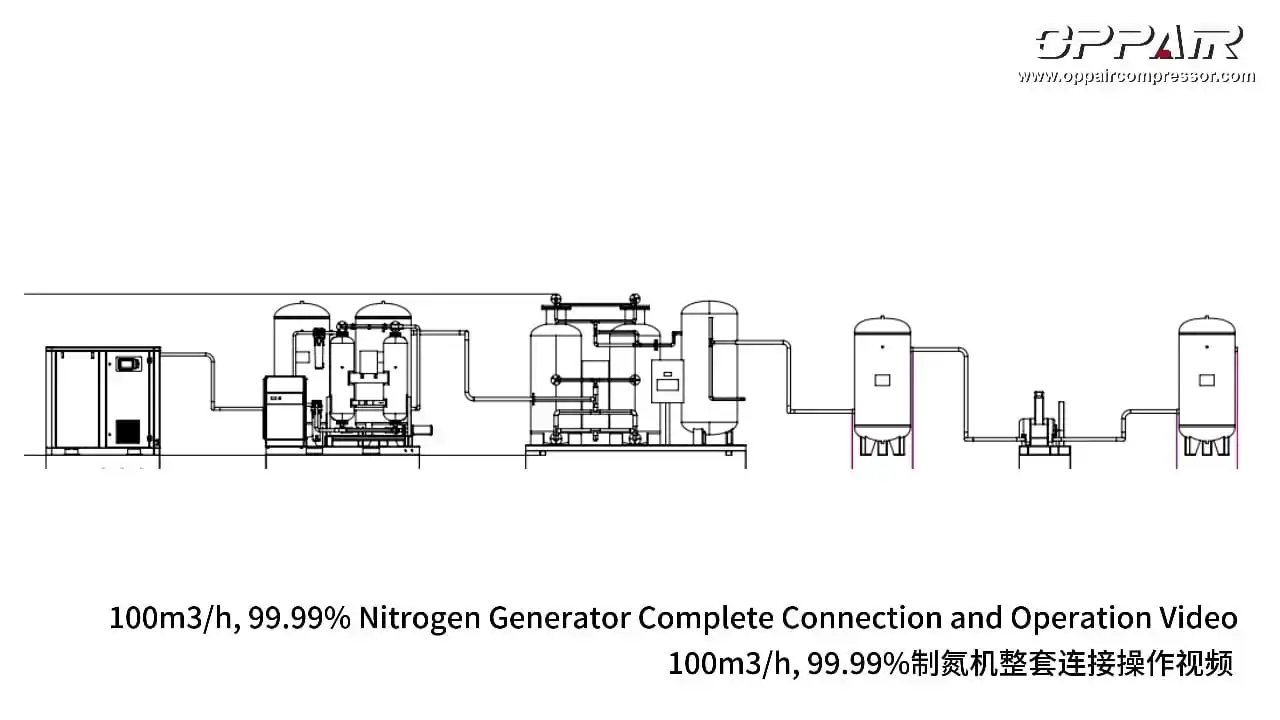
▲ Complete System Piping Schematic: From Air Compressor to High-Pressure Nitrogen Storage
The complete pipeline connection sequence consists of nine interconnected units installed in strict series order:
- OPPAIR Rotary Screw Air Compressor (Stationary / Permanent Magnet VFD): Delivers continuous, stable industrial compressed air as the initial feed gas source.
- Primary Compressed Air Storage Tank: Acts as a pressure buffer to eliminate airflow pulsations, cool the incoming compressed air, and condense out bulk liquid condensate via bottom drain valves.
- Refrigerated Air Dryer & High-Efficiency Coalescing Pre-Filters: Chills compressed air to 2-10°C pressure dew point, removing over 85% of vaporized moisture along with aerosolized oil droplets and solid particulates.
- Twin-Tower Adsorption Desiccant Air Dryer (Tower A & Tower B): Utilizes high-grade desiccant media under alternating pressure-swing regeneration to achieve deep moisture removal down to -40°C ~ -70°C pressure dew point.
- Ultra-Clean Dry Air Buffer Tank: Stores and stabilizes ultra-clean, dry compressed air, preventing inlet pressure fluctuations during rapid PSA valve switching cycles.
- PSA Nitrogen Generator Skid (Dual Adsorption Towers A & B): The core separation unit packed with premium Carbon Molecular Sieve (CMS). Utilizing the differential diffusion rates of oxygen and nitrogen under pressure, oxygen molecules are selectively adsorbed within the micropores while nitrogen passes freely into the discharge header.
- Nitrogen Buffer Storage Tank: Receives 99.99% pure nitrogen from the PSA towers to smooth out cyclic concentration and pressure variations.
- Nitrogen Booster Compressor (High-Pressure Reciprocating Unit): Elevates the regulated nitrogen gas from baseline generator pressure (0.6-0.8 MPa) up to targeted medium/high pressures (1.5-3.0 MPa / 15-30 bar) required by modern laser cutting machines.
- High-Pressure Nitrogen Storage Vessel: Final pressurized nitrogen reservoir connected directly to plant distribution manifolds and laser cutting heads.
2. Critical Safety Precautions Before Operation
Before performing any electrical power connection, pneumatic valve commissioning, or system startup, all operators and maintenance technicians must observe three fundamental safety mandates:
- Thorough Manual Review: Read and understand the complete OPPAIR operating instruction manuals for the air compressor, refrigerated dryer, adsorption dryer, PSA nitrogen generator, and booster compressor.
- Personal Protective Equipment (PPE): Always wear approved safety helmets, industrial safety glasses, hearing protection (earmuffs/earplugs), and protective gloves during machine commissioning and operational rounds.
- Zero-Pressure Disassembly Ban: Never attempt to loosen fittings, open inspection ports, disconnect flexible hoses, or service pneumatic valves while any section of the piping network or pressure vessel remains pressurized. Always perform Lockout/Tagout (LOTO) and manually vent all vessels to 0.00 MPa before maintenance.
3. Step-by-Step Standard Startup Procedure (5-Step Sequence)
Starting a multi-stage nitrogen generation station requires strict adherence to chronological order. Prematurely starting air compressors without pre-cooling dryers, or starting boosters without adequate suction pressure, will lead to system alarms, water ingress, or equipment tripping.
Step 1: Turn On the Refrigerated Air Dryer
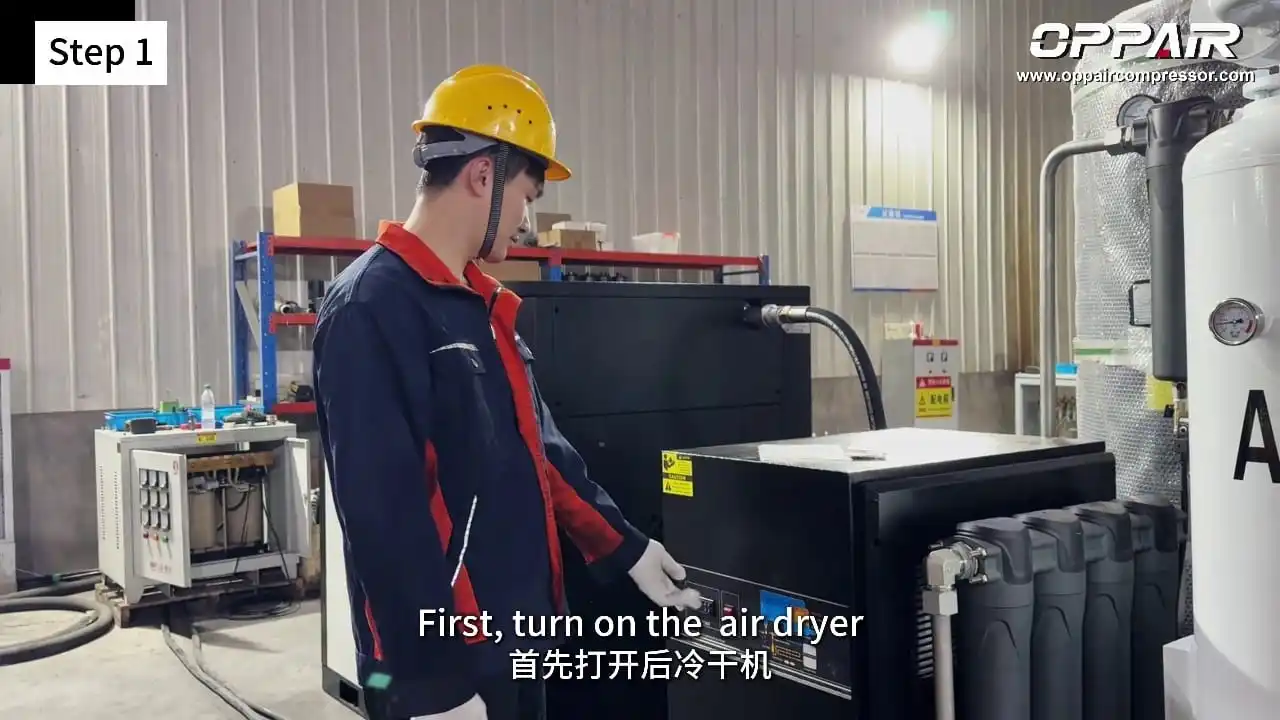
▲ Step 1: Powering on the refrigerated air dryer to establish refrigeration cycle
Press the power switch on the refrigerated dryer control panel. Starting the refrigerated dryer first allows the internal refrigerant compressor and evaporator to pull down to optimal operating temperature (2-10°C dew point) prior to introducing hot compressed air.
Step 2: Turn On the Air Compressor After 3 Minutes
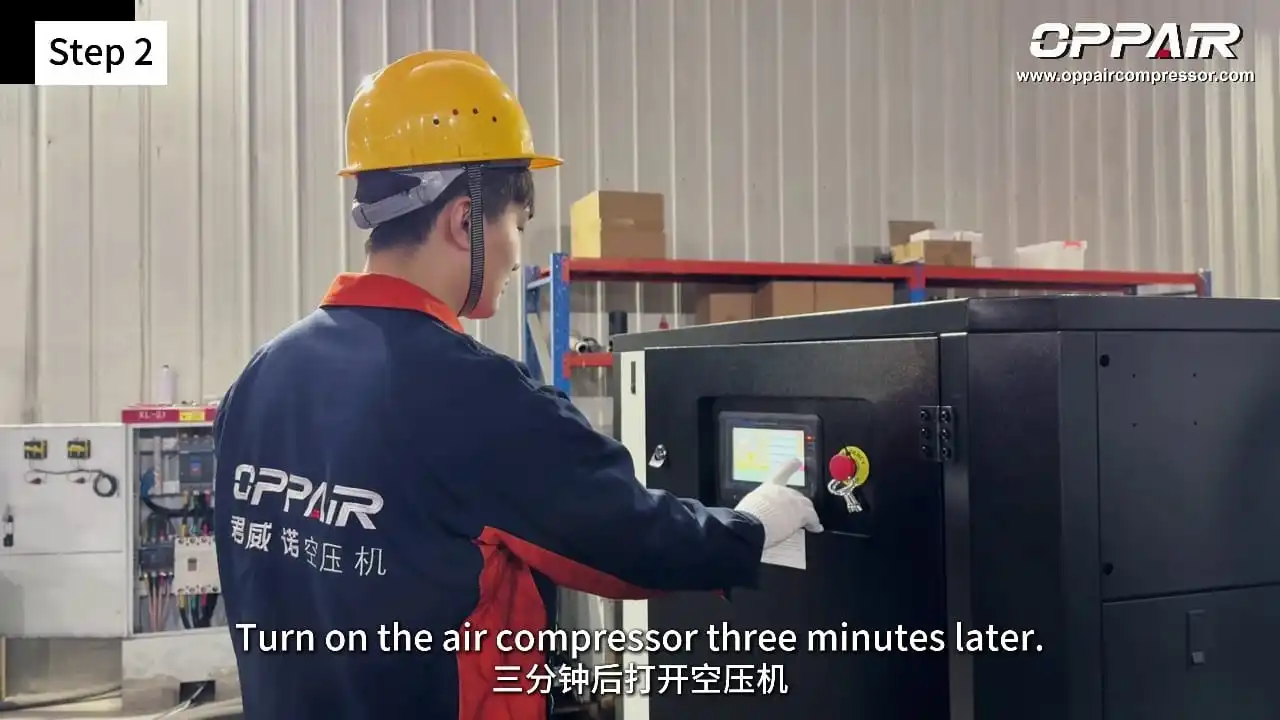
▲ Step 2: Starting the OPPAIR screw air compressor 3 minutes after dryer pre-cooling
After a mandatory 3-minute pre-cooling dwell time, press the start button on the OPPAIR screw air compressor touch screen. The compressor will enter soft-start acceleration, close the blowdown valve, and begin delivering pressurized air into the primary air tank and refrigerated dryer.
Step 3: Turn On the Adsorption Dryer When Air Tank Pressure Reaches 0.6 MPa
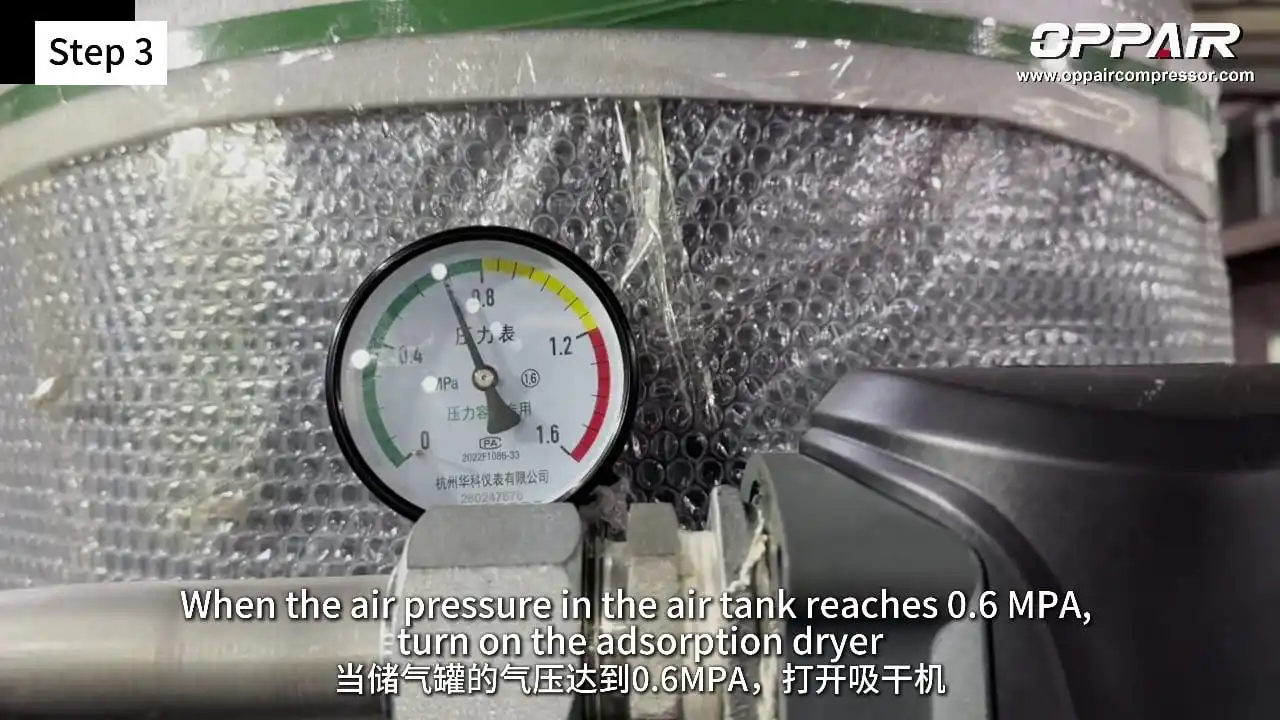
▲ Step 3: Verifying air tank pressure reaches 0.6 MPa before activating twin-tower adsorption dryer
Monitor the mechanical pressure gauge on the primary air storage tank. When line pressure reaches 0.6 MPa (6.0 bar), turn on the electrical control switch of the twin-tower adsorption dryer. Ensuring at least 0.6 MPa before switching prevents desiccant bed fluidization, dust attrition, and purge valve short-cycling.
Step 4: Turn On the PSA Nitrogen Generator Skid & Stabilize for 25 Minutes
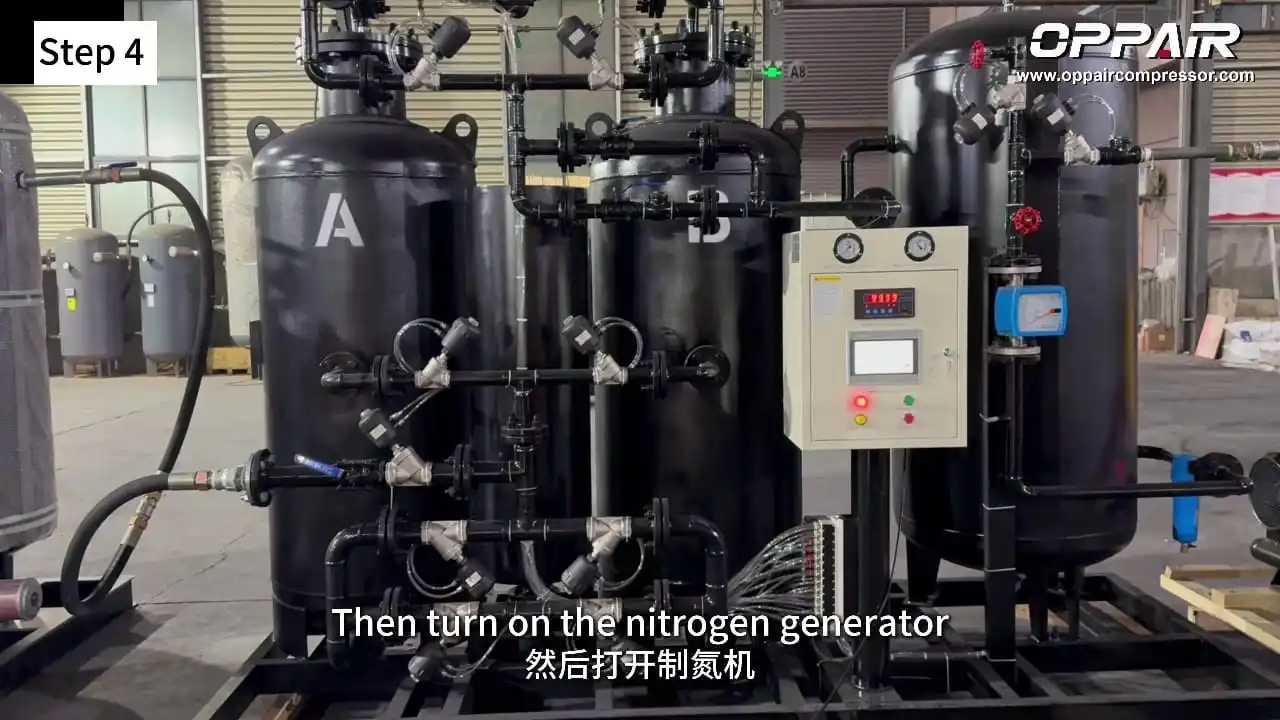
▲ Step 4: Activating the PSA nitrogen generator PLC control panel and valve manifolds
Turn on the power switch on the main electrical control cabinet of the PSA nitrogen generator. The automated Siemens PLC controller will begin sequential alternating cycles between Tower A and Tower B via pneumatic angle-seat valves (adsorption, pressure equalization, desorption, and purge).
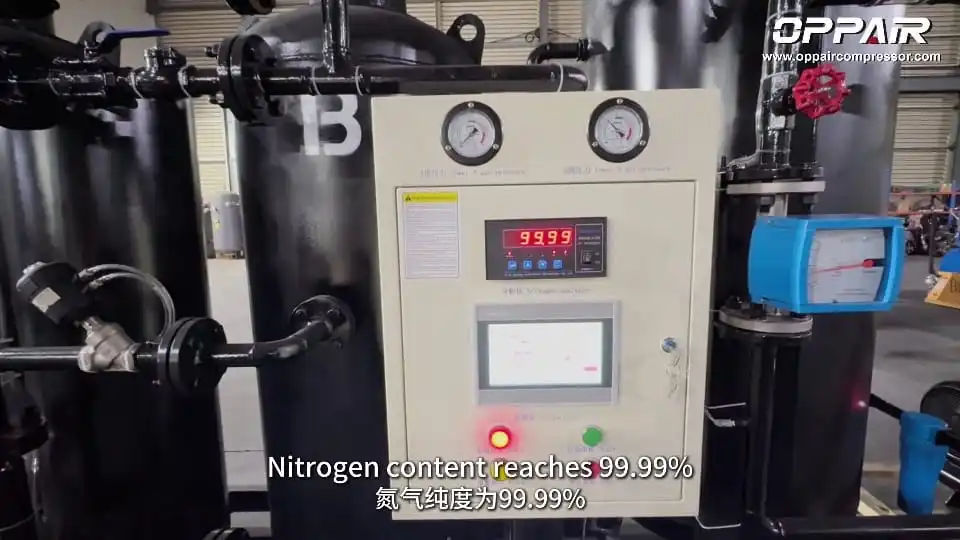
▲ High-Precision Online Analyzer: Nitrogen purity stabilizes at certified 99.99% after approx. 25 minutes
Purity Stabilization Dwell Time: Allow the system to run in auto-venting / circulation mode for approximately 25 minutes. Observe the digital nitrogen purity analyzer on the front cabinet door. As residual air in the molecular sieve beds is completely flushed, the digital LED readout will climb steadily until it displays certified 99.99% high-purity nitrogen.
Step 5: Turn On the Nitrogen Booster Compressor at 0.6 MPa
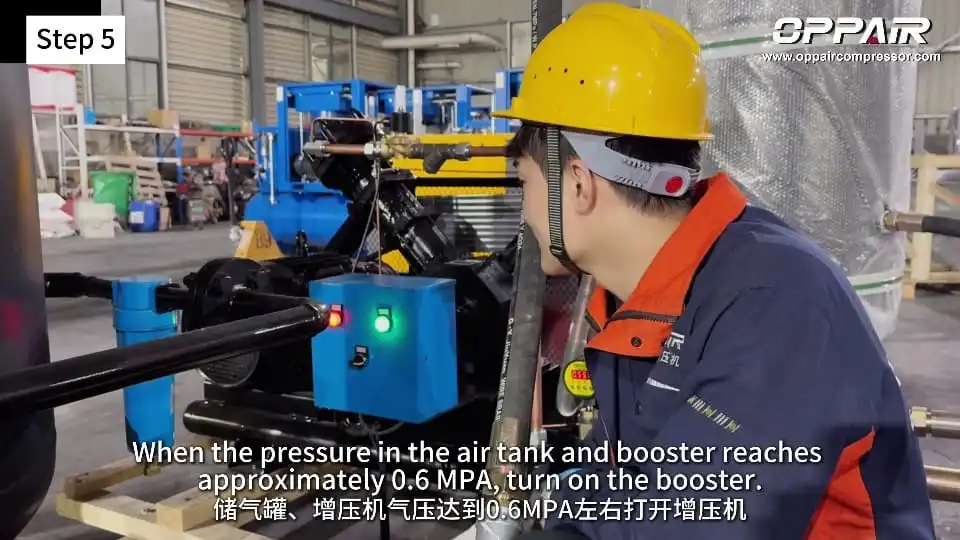
▲ Step 5: Verifying suction pressure reaches 0.6 MPa on digital pressure switch before booster activation
Check the intermediate nitrogen buffer tank and the digital suction pressure controller on the nitrogen booster compressor. When suction pressure reaches approximately 0.6 MPa (6.0 bar), engage the start button on the booster compressor electrical box. The booster will pressurize the 99.99% nitrogen into high-pressure storage tanks, completing the full commissioning cycle.
4. Reverse-Order Safe Shutdown Sequence
Shutting down an on-site nitrogen generation station requires exact reverse chronological order. Never shut down the air compressor while the booster compressor or nitrogen generator is running, as this creates upstream negative pressure, draws desiccant dust into valves, and triggers severe mechanical stress.
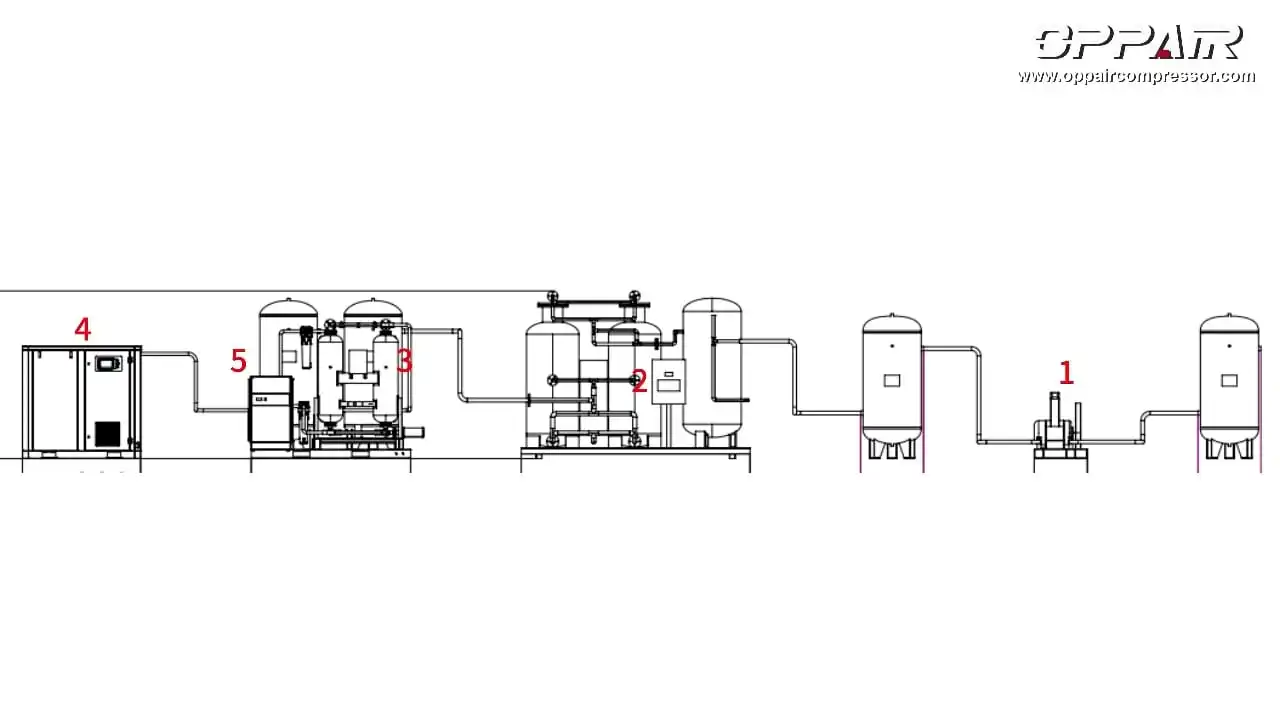
▲ Reverse Shutdown Sequence: Booster (1) → Nitrogen Generator (2) → Adsorption Dryer (3) → Air Compressor (4) → Refrigerated Dryer (5)
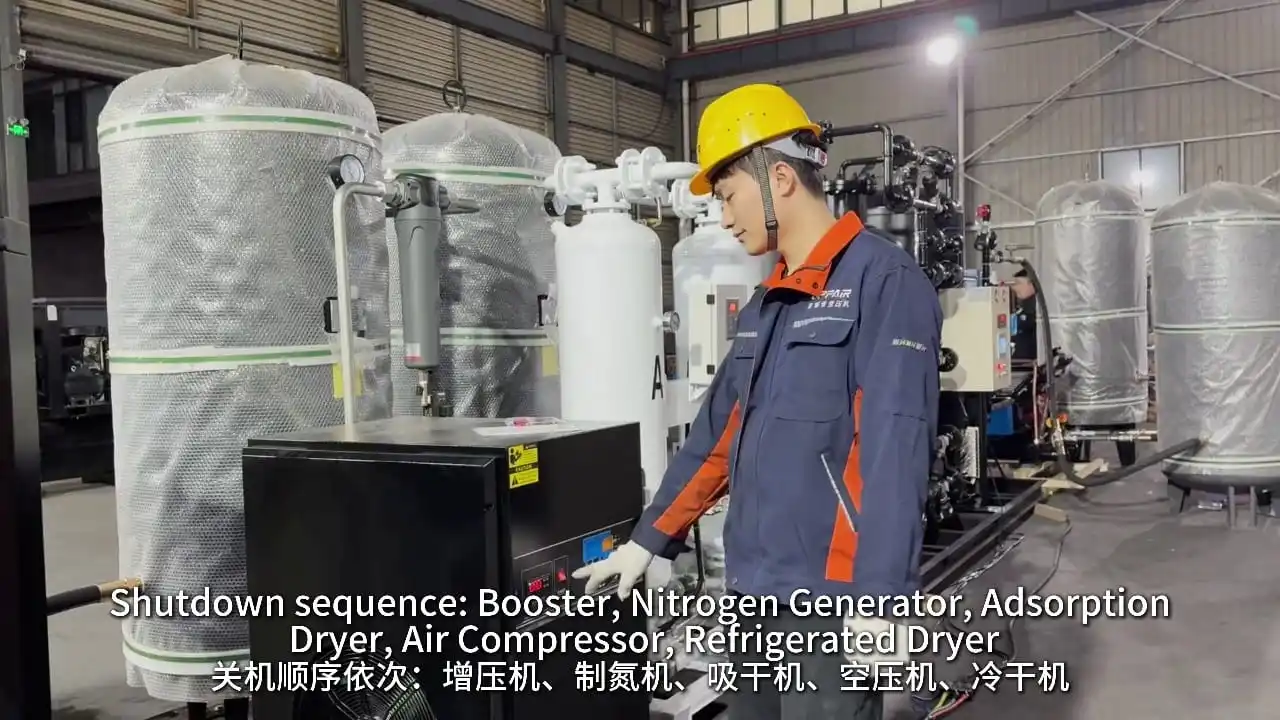
▲ Certified Operator Executing Step-by-Step Equipment Shutdown
Execute shutdown in the following strict order:
| Shutdown Step | Equipment Unit | Engineering Rationale |
|---|---|---|
| 1st | Nitrogen Booster Compressor | Stops high-pressure compression load immediately; prevents vacuum cavitation or dry running on suction inlet valves. |
| 2nd | PSA Nitrogen Generator Skid | Shuts off automated cycle valves while CMS towers remain pressurized under inert nitrogen, protecting molecular sieves from air exposure. |
| 3rd | Twin-Tower Adsorption Dryer | Terminates desiccant regeneration heating and purge flow without sudden pressure drop. |
| 4th | Screw Air Compressor | Stops raw air generation; allows compressor to undergo automated unload cycle and blowdown. |
| 5th | Refrigerated Air Dryer | Turned off last to ensure all residual warm moisture in pre-filter housings and heat exchangers is fully condensed and discharged. |
5. OPPAIR Turnkey On-Site Nitrogen Solutions
OPPAIR provides complete skid-mounted and modular on-site PSA nitrogen generation stations ranging from 10 m³/h to 500 m³/h with purity levels selectable from 95% to 99.999%. Engineered with energy-saving permanent magnet variable frequency screw compressors, heavy-duty adsorption beds, and smart PLC touch screen telemetry, OPPAIR turnkey nitrogen packages eliminate high liquid nitrogen delivery fees and high-pressure bottle leasing costs.
Whether you operate high-power fiber laser cutting centers, electronics surface-mount assembly lines, or pharmaceutical packaging cleanrooms, OPPAIR engineering teams deliver custom-tailored turnkey gas separation systems engineered for 24/7 industrial duty.
OPPAIR is looking for global agents, welcome to contact us for inquiries:
📞 TEL/Wechat/WhatsApp: +86 14768192555
📧 Email: Info@oppaircompressor.com
🌐 Website: https://www.oppaircompressor.com/
#High Pressure Low Noise Two Stage Air Compressor Screw
#All in one screw air compressors
#Skid mounted laser cutting screw air compressor
#oil cooling screw air compressor
#oil free compressors
Post time: Nov-16-2026


